
Updated 2026-07-02 · 6 min read
What is plug-in solar?
A plain-English guide to balcony and plug-in solar: what it is, what's in a kit, who it helps, and what it doesn't replace.
The plain-English definition
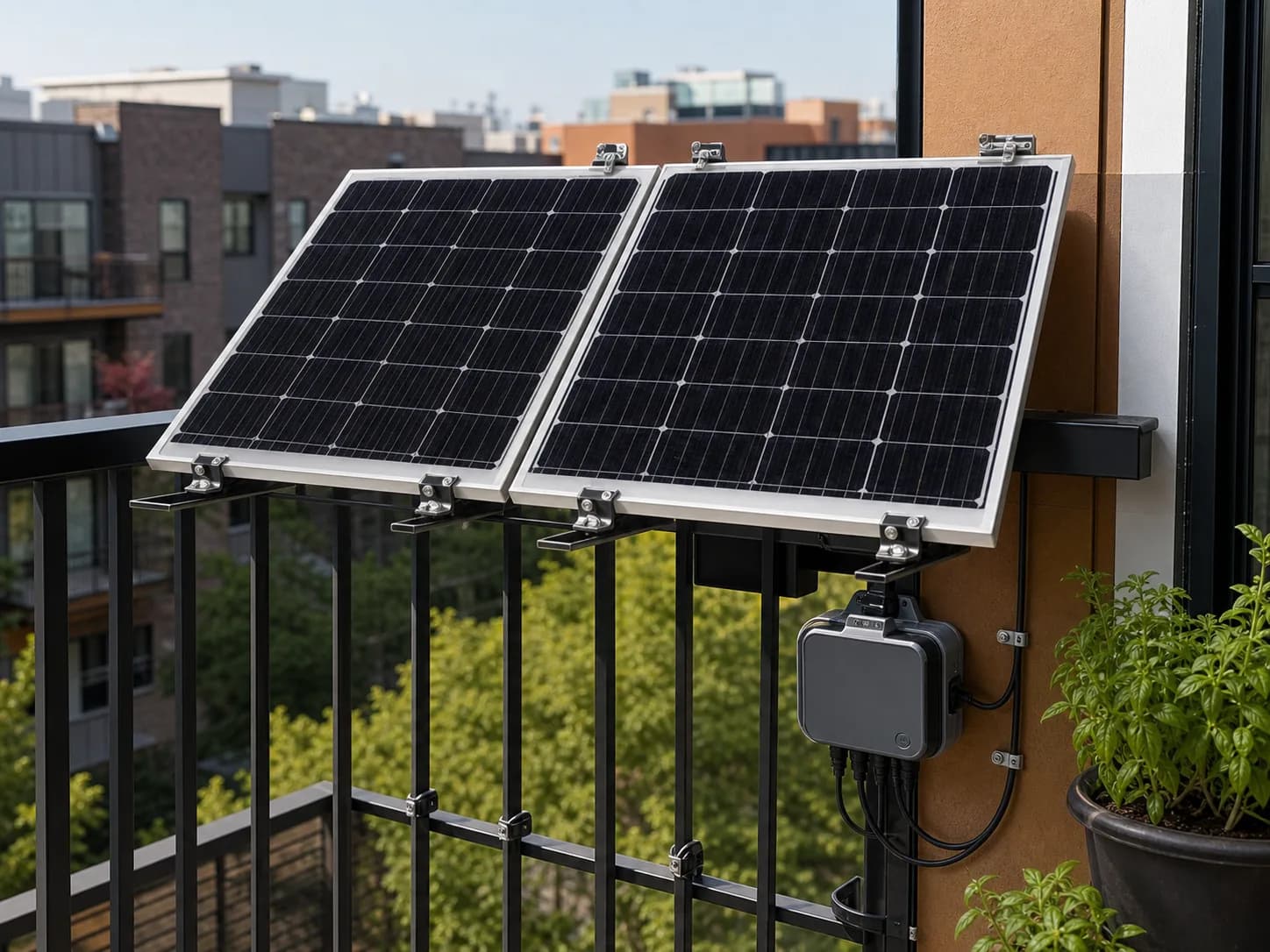
Plug-in solar — also called balcony solar or plug-and-play solar — is a small solar system designed to lower part of your electric bill without a permanent rooftop installation. Instead of an electrician hard-wiring panels into your house, you set up a compact kit on a balcony, patio, fence, or yard and connect it with a plug.
The Clean Energy States Alliance, a nonprofit group of state energy officials, describes these systems simply: they plug in like an appliance, but instead of drawing power the way a toaster does, they send power the other way — into your home for other devices to use.
Solar panels are sometimes called photovoltaic panels, or PV for short — "photovoltaic" just means "turns light into electricity." Throughout this site we'll mostly just call them solar panels.
What's in a kit
Kits vary, but almost all of them contain the same five kinds of parts:
One or more solar panels that turn sunlight into electricity. An inverter — the box that converts the panels' electricity into the type your home's outlets use (more on that in our how-it-works guide). A cable and plug to connect it to your home. Mounting hardware to hang or stand the panels on a railing, wall, fence, or ground frame. And, in some kits, a small battery to store energy for later or an app to monitor output.
One distinction matters more than any other when you shop: a complete, tested system is not the same as a bundle of individually tested parts. A safety-listed panel plus a safety-listed inverter does not automatically add up to a safety-listed plug-in solar system. We explain why that difference matters — and how to check for it — in the safety guide and buyer's guide.
What it can and can't do
Here's the honest picture. A plug-in kit is small — typically rated between 300 and 1,200 watts, roughly the draw of a hair dryer at full tilt. It can meaningfully offset the "always-on" electricity your home uses during the day: the refrigerator, the Wi-Fi router, standby electronics, fans, a laptop, or part of an air conditioner's load. Over a year, that adds up to a modest but real cut in your bill.
What it can't do is run your whole home, charge an electric car at normal speed, or replace your utility connection. Think of it as trimming your bill, not eliminating it.
It's also not a backup generator. Most plug-in systems are designed to shut off automatically when the grid goes down — a safety feature, not a flaw — so they won't keep your lights on during an outage unless the product is specifically built and certified for backup. We cover why in the how-it-works and safety guides.
Who it's for
Rooftop solar assumes you own a suitable roof, plan to stay, and can afford a five-figure installation. That rules out a lot of people. The World Resources Institute, an independent research organization, notes that roughly a third of U.S. households rent — and renters, apartment dwellers, and people with shaded or aging roofs are largely locked out of rooftop solar.
Plug-in solar is one of the few ways those households can generate their own electricity. Because there's usually no roof work, no permit in some places, and no electrician, the extra "soft costs" that make rooftop solar expensive can shrink or disappear. That's the real promise: solar for people rooftop solar has always skipped.
Why it's suddenly a big deal in the U.S.
Plug-in solar has been common in Europe for years — Germany alone has hundreds of thousands of registered systems — but the United States is only now building the rules and safety standards to support it.
Two things changed quickly. In 2025, Utah passed the first U.S. state law written specifically for plug-in solar. Then, on January 8, 2026, UL Solutions — a long-established product-safety testing company — launched the first U.S. testing and certification program built for these systems. Since then, dozens of states have introduced their own bills. Our state tracker follows where each one stands.
What to check before you buy
Because plug-in solar is small and easy to set up, it's tempting to treat it like any other online purchase. Resist that. A plug does not mean "legal anywhere" or "safe in any outlet."
Before you spend money, four things need to line up: your state's rules allow it, the specific kit is certified as a complete system, your balcony or yard can hold it safely and gets enough sun, and the numbers make sense for your bill. Our buyer's guide walks through each check in order.
Be especially skeptical of the phrase "standard outlet." Some laws and product pages use it loosely, but the U.S. safety standard points toward specific plugs, outlets, and circuit parts rated to handle electricity flowing backward into them. Treat outlet compatibility as a real technical requirement, not marketing.
FAQ
Is plug-in solar the same as rooftop solar?
No. Rooftop systems are large, permanently bolted down, and wired in by an electrician. Plug-in systems are small, movable, and connect with a plug. Rooftop solar can cover most of a home's electricity; plug-in solar trims a slice of it.
Can a renter really use it?
Often, yes — that's the whole point of the category. But it only works if your state's rules, your lease or building rules, a safe place to mount it, and a certified product all line up. Check those before buying.
Do I need an electrician?
Many kits are designed for you to set up yourself, and some state laws specifically allow self-installation. But a few states or buildings still require an electrician or a dedicated outlet. Your state page and the product's instructions will tell you.
Sources
- What States Need to Know About Plug-In SolarClean Energy States Alliance; accessed 2026-07-02
- What to know about plug-in solarSolar United Neighbors; accessed 2026-07-02
- How States Can Unlock Affordable Plug-In SolarWorld Resources Institute; accessed 2026-07-02
- The Rise of Plug-In Solar: How States Can Reduce Costs and Streamline Clean Energy AdoptionNational Caucus of Environmental Legislators; accessed 2026-07-02
- UL Solutions Debuts Testing and Certification Framework for Safer Plug-In Solar Across the United StatesUL Solutions; accessed 2026-07-02
- UL 3700 Outline of Investigation for Interactive Plug-In Photovoltaic Equipment and SystemsUL Standards & Engagement; accessed 2026-07-02