
Updated 2026-07-02 · 6 min read
How does plug-in solar work?
Follow the electricity from panel to plug to your home — and understand why the outlet connection is the part that needs care.
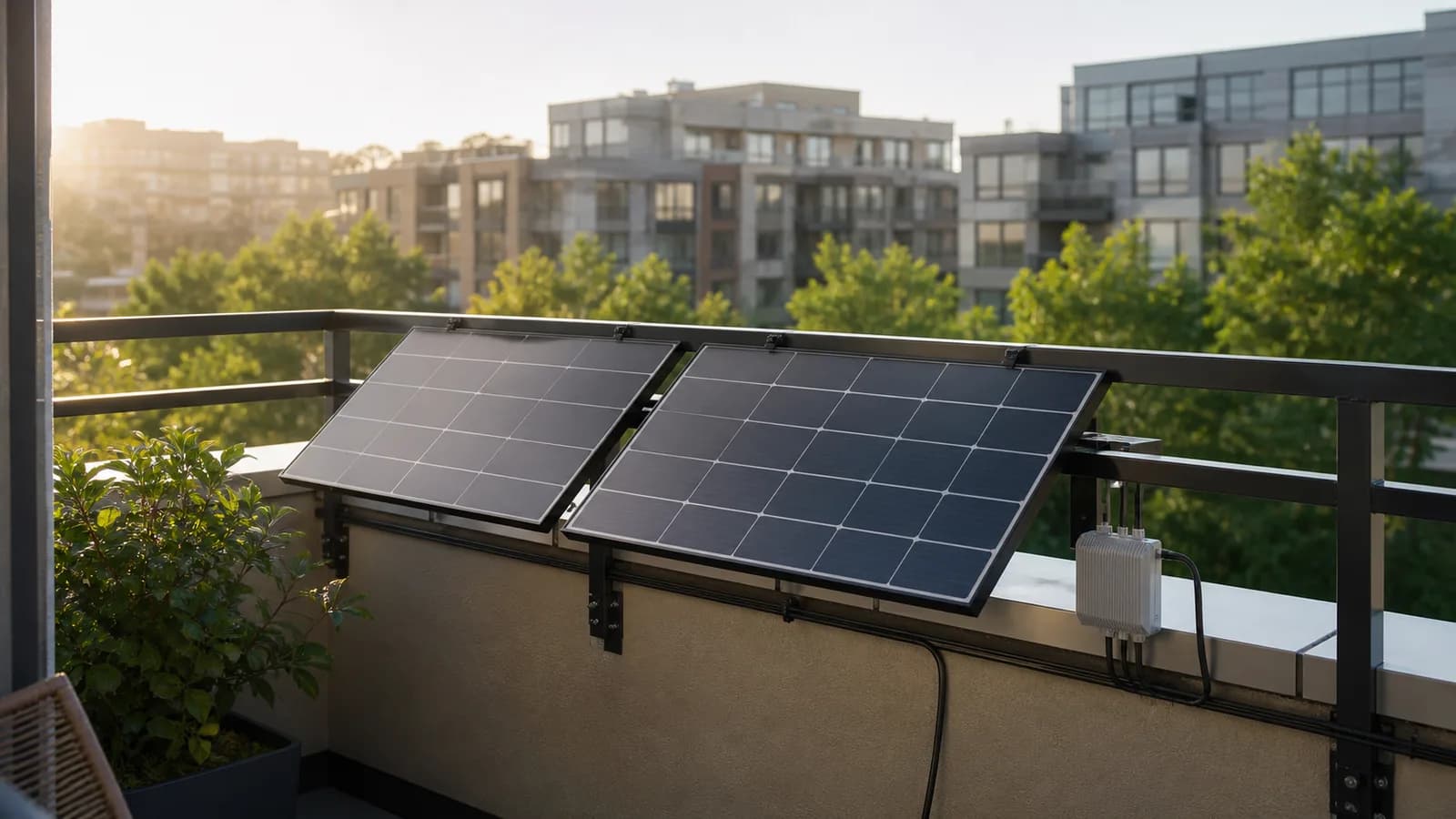
Follow the electricity, step by step
Start at the panel. When sunlight lands on a solar panel, it produces electricity in a form called direct current, or DC — the same steady kind of electricity a battery gives you. Your home's outlets don't use DC, though. They use alternating current, or AC, which rapidly switches direction many times a second. Nearly everything you plug in expects AC.
So the kit includes an inverter: a small box whose only job is to convert the panels' DC into AC and keep it perfectly in step with your home's electricity. Once converted, that solar electricity travels through the cable and plug into your home's wiring, ready for any appliance to use.
Why your bill goes down
Here's the key idea, and it surprises a lot of people: the panels don't power one particular appliance. They simply add electricity to your home's wiring, and whatever is running nearby uses it.
A useful way to picture it: your home is always sipping electricity from the utility. When your solar kit is producing, it tops up that supply from your side, so your home sips less from the utility at that moment. If your home is using more than the panels are making, the grid quietly fills the gap. You barely notice anything except a smaller bill.
What happens if you make more than you use
Because a plug-in kit is small, most of the time your home is using everything it produces. But on a bright afternoon when little is running, the panels might make more than the house needs.
When that happens, one of a few things occurs, depending on your system and local rules. The extra electricity may flow out to the grid ("export"). Some systems have a control that prevents export entirely ("zero-export"). If there's a battery, the extra can charge it for the evening. And if none of those apply, the system may simply hold back some output. This matters for savings, because exported electricity is often worth little or nothing unless your state and utility specifically pay for it — a point we dig into in the savings guide.
The outlet is the part that needs care
Solar panels making electricity is nothing new — rooftop systems have done it for decades. The genuinely unusual thing about plug-in solar is sending that electricity backward through a plug into a circuit, when household outlets and wiring were designed for electricity flowing the other way, out to your devices.
That reversal is manageable, but it's exactly why plug-in solar isn't just another appliance. The plug, the outlet, and the safety devices on that circuit all need to be rated to handle electricity moving in both directions. This is the reason the U.S. safety standard is cautious about the loose phrase "any standard outlet," and why the whole system — not just the panel or inverter — needs to be certified. The safety guide covers this in depth.
Why it turns off during a blackout
This part confuses people, so it's worth being clear. When the power grid goes down, a normal plug-in solar system is designed to stop producing within a fraction of a second. That's a required safety behavior called anti-islanding.
The reason is safety for other people. If your system kept pushing electricity onto the wires during an outage, it could put a dangerous voltage on lines that utility crews and electricians believe are dead. So compliant equipment shuts itself off until the grid returns. A few products include a special, separately-certified backup mode that can power a limited set of devices during an outage — but it only works safely when the product is specifically designed and listed for it. Never assume an ordinary plug-in kit will keep your lights on in a blackout.
FAQ
What's the difference between DC and AC electricity?
Direct current (DC) flows steadily in one direction, like from a battery — it's what solar panels produce. Alternating current (AC) rapidly reverses direction and is what your home's outlets and appliances use. The inverter's job is to convert the panels' DC into AC.
Does the solar electricity go to a specific appliance?
No. The panels add electricity to your home's wiring, and whatever is running at that moment uses it. The practical effect is that your home draws less from the utility, which lowers your bill.
Will it keep working during a power outage?
Usually no. Standard systems are built to shut off the instant the grid goes down, to protect utility workers. Only products with a specific, certified backup mode can power devices during an outage.
Sources
- UL Solutions Debuts Testing and Certification Framework for Safer Plug-In Solar Across the United StatesUL Solutions; accessed 2026-07-02
- UL 3700 Outline of Investigation for Interactive Plug-In Photovoltaic Equipment and SystemsUL Standards & Engagement; accessed 2026-07-02
- IEEE 1547-2018IEEE Standards Association; accessed 2026-07-02
- What States Need to Know About Plug-In SolarClean Energy States Alliance; accessed 2026-07-02